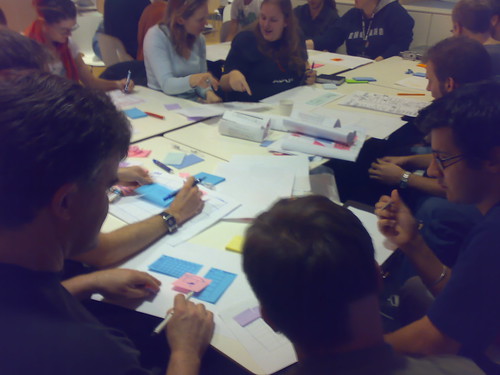
For my recent BarCamp session I shared a design technique that a colleague and I developed quite recently that we’ve found to be quite successful in both generating great design ideas and developing consensus about the design approach for projects within a multi-disciplinary team.
We call this technique Design Consequences, due to the similarity it has with the similarly named childrens games. We tend to use it in the earlier stages of the design process, although it can be used for more detailed interface design problems.
So, how does it work? It’s pretty simple really.
What you need:
- a clearly articulated design problem and design goal(s) – for the BarCamp exercise our design problem was to design an electronic version of the BarCamp session wall where people could add their own session and choose which sessions they were going to attend.Â
- some design ideas or components – when I do this in a client context, we do this by spending time beforehand looking at our specific challenges and seeing how other people have approached them, and trying to understand design techniques or principles that work (as well as those that don’t). This gives people access to a much greater repoirtore of ideas to draw in the Design Consequences exercise.
- a multi-disciplinary team – try to get the entire team if you can. The exercise works best with no more than 8 people involved, but it can be done with more if required. Get management to the table, bring all kinds of designers, bring the product managers and marketers, bring your developers. Bring everyone you can, as long as they’re familiar with the project and the design problem.
- lots of paper and markers and post its – make them as colourful and fun as possible. Make it look like a crafting session. A sense of play and enjoyment is key to this exercise.
- some examples of the type of output you’re expecting – anything that starts with the word ‘design’ can be very intimidating and scary. Lots of people ahve been told throughout their lives that they can’t draw, or that they aren’t creative. I have some *very* scratchy samples that have been created by people who design for a living. I show these before we get started so that people realise quickly that pretty drawings are not part of the equation.
- A bundle of energy – you need to be just a little bit hyper to run this exercise :)
What you do:
- Round One – everyone has seven minutes to design, individually, the the first page that users would see when confronting the ‘design problem’. So, a typical example would be a website homepage, but it could be any part of an application or website or even, say, an email. The faciliator(s) should participate, but keep an eye on the clock and give some warnings with a few minutes to go, and again at about 30 seconds.
- Round Two – here’s the consequences twist. Everyone picks up the page they’ve designed, then passes it on to the person on their right (or left, it doesn’t really matter). Everyone then has to review the page they’ve received (ask for clarification from the original designer if it’s a little sketchy in places), then decide – if you were the user, what would *you* interact with, and what would happen next. You have seven minutes to draw ‘what happens next’. (Don’t tell people about Round Two before Round One, it’s much more fun when it’s a bit of a surprise).
- Show and Tell – we then go around in a circle and each person describes the page they received, what aspect they chose to interact with and why, and then describes what they designed next. Discussion is encouraged.
What do you get? Lots of great data, and lots of great conversation fodder.
It’s a good idea to capture as much of this as possible as you go around the group. Of course, the best way to do this is to write up ideas onto post it notes as you go and stick them on the wall. There should be an ‘in’ section of the wall and an ‘out’ section of the wall. (‘In’ means that the idea has legs for this particular design problem). Affinity sorting on the run also helps to draw out the key themes or ideas that have emerged from the exercise. You should be leading the group discussion, helping the group to gain consesus and make decisions as to the design approach to be taken in solving the design problem, and trying to document these decisions as you go.
This process can be quite time consuming and intense, but more often than not there will be a few key ideas that the group is particularly enthusiastic about and that really propels the decision making.
By the end of the session you should be in a position where everyone is in agreement about *what* will be included in the wireframes that comprise the next phase of the design process.
Why would you use this approach?
- It makes a great change from the talk-fest of meetings
- It generates lots of ideas – and often some really great onesÂ
- It stops people getting to attached to their design ideas and makes evaluation and critiquing more effective
- It helps get all the team feedback and ideas into the pot (in particular, it’s great to get management and technical input at this stage)
- It drives buy-in, involvement and consensus
- It pulls in cross-discipline scills (for example, developers are often really great at quickly identifying great ID approaches for Rich Internet Applications)
- You’d be amazed what you learn earlier rather than later by involving the entire team at this early stage
- Getting lots of brains involved in the design process can uncover some really creative gems
- It makes the design process faster
- It’s fun!
So, there you have it. Some quick notes on a technique that’s been quite useful for me lately. I’d be interested to hear what you think of it and if you try it, to see if you too find it useful.
